Type distinction, features, respective characteristics and purchase advice for recumbent bikes
This page is generally aimed at recumbent bike beginners.
Our own recumbent bikes do not appear here, because we do not want to suggest such an
investment to a beginner before he could get to know his individual preferences and
requirements for a recumbent bike through his first experiences.
But beware - The experiences and thoughts written here could "subtly" make the Earthglider
appear in the positive light! After all, it is precisely the experiences and thoughts presented
here that have created the Earthglider in its present form.
In any case, we strive to objectively explain the properties, the advantages and
disadvantages of the different types of recumbents.
The inexperienced recumbent cyclist feels rather unfamiliar with all the different (thwo wheeler-)
types of recumbent bicycles at the beginning. First when he has completed a few hundred
kilometers of recumbent practice the beginning recumbent cyclist will get a sense of which recumbent bike could be suitable for him.
But If you have become fundamentally familiar with any recumbent bike, you will quickly find your
way around with other recumbent bikes and you will quickly realize which recumbent bike you
like and which one you don't. It's truely just about the first recumbent bike experiences ever.
In general, we recommend renting a recumbent bike for a few tours at the beginning or
buying an old cheap bike to achieve a general familiarity with a (two wheeler) recumbent bicycle.
The great variety in the very different offers and the low chance of finding a suitable and preferential recumbent
bike from the beginning is probably one of the main reasons for the still low distribution of
recumbent bikes.
We hope through this text we can help to find a suitable type of recumbent bicycle before this
experience had to be painstakingly acquired, this text makes an appetite for a good
recumbent bike and it can support the spread of these comfortable, fast and effortlessly
driving superior bicycles.
General information and requirements for recumbent bikes
Recumbent bikes should have a suspension.
Unlike upright wheels, the recumbent cyclist cannot cushion shocks and uneven ground with
the body or with the arms or relieve vibrations with the arms in which he walks out of the
saddle.
Depending on the seat position, the rear suspension is generally more important than the
front suspension. It is also possible that a combination of braced fabric seats with wide
balloon tires and lower tire air pressures is sufficient in this sense.
The joints themselves are only slightly stressed despite the hard impacts, because the entire
body in the seat shell is held comfortably with a headrest, so that the joints do not have to
work against the shocks. Nevertheless, the organs are shaken through and a completely
unsprung recumbent bike, for example, does not always get the kidneys so well in the long
run
A rear-view mirror is indispensable because it is difficult for the recumbent cyclist to twist his
neck as gallantly as an upright cyclist. The upright wheeler can twist the entire back, while the
recumbent ecycler is slightly more restricted by the backrest. Probably, some accidents with
recumbent bikes are caused by the fact that in certain situations the drivers are not able or
too comfortable to adequately view the traffic in the respective direction to the rear or to the
side rear.
Click pedals make recumbent cycling considerably more comfortable. There are also some
experienced recumbent cyclists who do not need a click pedal. But when the feet are firmly
connected to the pedal, the effort alone to keep the feet on the pedals is much lower and you
can bring considerably more strength to the road without overloading the muscles and joints.
It makes sense to make the first experiences with recumbent bikes possibly without a click
pedal and only then touch the use of click pedals until you regularly drive with click pedals.
Basically, the release from the click pedals is very easy by turning the foot. If you are used to
this, you can get your foot on the ground very quickly even in unexpected situations. It's all a
matter of getting used to and then you don't want to miss the clickies anymore.
Click pedals even offer additional security, because in "wild" driving situations (e.g. bumps) is
much better connected to the wheel and keeps this better under control. Even with falls, it can
be beneficial to be well connected to the bike (especially as long as the bike slips ahead
with the wheels).
Personally, I don’t want to miss a good headrest anymore! In addition to the enormous
comfort gain, a robust and large-area headrest can also reduce the risk of injury in the event
of a rear crash (which has so far received attention with a few recumbent bikes).
The extent to which a headrest is important for comfort also depends on the tightness of the
seat. Backrest angles of below 32° require significantly more force to maintain the head
without support. With headrest, very flat backrests can be amazingly comfortable and suitable
for long distances.
The low seat height of recumbent bikes is first of all the biggest psychological hurdle for the
changeovers, because it is associated with a feeling of insecurity in traffic. And indeed, this
low seat height also offers dangers. But it also offers an enormous amount of security,
because the risk of injury in the event of falls is significantly reduced. The number of bicycle
accidents without "foreign participation" and with nevertheless considerable injuries is
generally underestimated and here recumbent bikes offer immense advantages. And this
advantage is obviously the greater the lower you sit. The low seat height is also
advantageous for the responsiveness in traffic. Low seat heights also have a positive effect
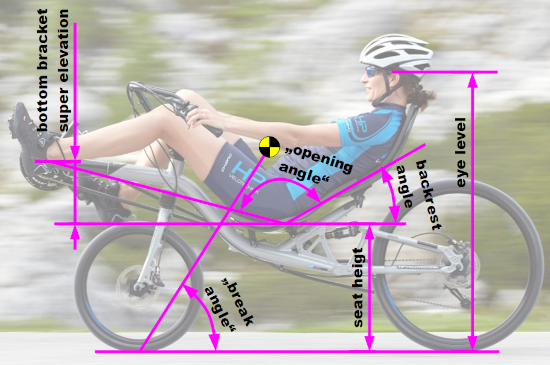
on the braking capability output (see "Brake Angle"). Everyday seat heights start at 30 to 40
cm. Higher wheels have typical seat heights up to 50 or 60 cm. For trikes and ultra-tie flyers,
seat heights of up to less than 20 cm are possible.
The actually decisive measure for the overview in traffic is the eye level. The eye level is of
course largely due to the seat height. However, the tendency to lean again plays a decisive
role. Steeper backrests, of course, require a greater eye level. A good compromise for eye
height in our experience is the height from which the driver can look through most of the side
windows of the cars and over most of the hoods of the cars. From this moment on, a very
good observation of the traffic is possible and the view through the cars should also be used
consciously. For backrest inclinations from 30° and seat heights from 35 cm, this eye level
can often be reached depending on the body size.
The backrest angle has a significant influence on the air resistance. Flat backrests
naturally provide lower air resistance. Flat backrests require greater effort of the neck
muscles to keep the head upright. Therefore, these headrests are recommended. The
headrests should be customizable so that the head is not pushed too far forward when the
backrests are flat, so that the chest and neck are not narrowed, which could affect breathing
during sporty driving. This sounds, if you read it this way, chilling, but a variety of experienced
recumbent cyclists report very relaxed riding even with very flat backrests. Everyone has to
find out for themselves.
A large bottom bracket super elevation generally has a positive effect on the air resistance in
the case of bicycles without fairing. Competition drivers often go so far that with a large tread position
increase and flat backrest angles, the knees and feet at the highest point protrude beyond the
eye level, which is of course only partially pleasant for everyday life. When using front or full
fairings, you should go in the other direction to be able to look out over the fairing on the road.
When driving with fairings on dirt roads, a "steep" viewing angle down on the road plays a
significant role in the timely detection of coverings with poor adhesion (split) or obstacles that
you want to avoid.
The "opening angle" (not an official designation, but used here) of the body at the hip joint has
ergonomic effects. Some recumbent cyclists feel a small opening angle (i.e. large tread level
increase and steep backrest) positively on the power development during kicking, because
the driver can better support himself against the backrest. Others prefer larger opening
angles to breathe more freely. The typical opening angles in recumbents are not so
fundamentally different from the opening angles of upright wheels.
The angle we refer to here as a "brake angle" means how well the wheel can brake. It is the
angle of the line from the center of gravity of the rider and wheel to the contact point of the
front wheel to the road. It can be assumed approximately that a tire on a dry road has a socalled
friction coefficient of 1. This means that the tire can withstand slipping away up to a
lateral force, which is as large as the weight. A braking angle of less than 45° would therefore
ensure that the wheel could utilize the maximum frictional force of the tire for braking without
overturning. The steeper this angle is, the weaker the usable braking power. In the case of
upright wheels, this braking angle is generally so bad that only about 50% - 60% of the
theoretically possible braking force can be used. Here, most recumbent bikes already offer
great advantages.
Especially with short legs, there is a conflict of objectives between good braking force and the
free movement of the front wheel to the heels. A front wheel lying far ahead naturally collides
with the heels when steering in strongly. As already mentioned, the recumbent cyclist quickly
gets used to this circumstance and stretches the inner leg of the curve when steering strongly
forward or twists the foot accordingly if he wants to continue to step through tight curves. If
you attach great importance to this free movement and therefore move the front wheel to the
rear, you lose considerable braking power. We rate the braking power as much more safetyrelevant
than the free movement of the feet, precisely because we are much faster with the
recumbent bike than with the upright wheel. Above speeds of about 15 km/h, such tight
curves are hardly possible anyway, in which the front wheel could collide with the heel. It's
just a matter of "manoeuvring."
Handlebar shapes
Essentially, three or four handlebar shapes have established themselves on recumbent bikes:
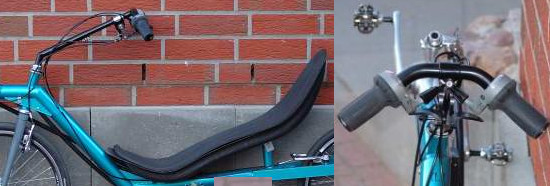
A lower handle bar is usually located under the seat and it is usually connected to the front wheel
steering via a push rod. We are talking about "indirect steering".
A lower handlebar is probably the most comfortable and relaxing way to steer a bicycle,
because the arms hang relaxed down, as they would without any activity.
The air resistance is noticeably greater due to the lower link, because the arms are
perpendicular to the air flow over the entire length and thus increase both the end face and
the Cw value. The energy saving resulting from the posture is probably exceeded by a
multiple by the additional expenditure of force to the drive. In addition, the manageability of
the bicycle in the lower handlebar is not quite as good as with the top handlebar. The
technical effort and weight are also slightly higher. Bottom handlebars and thighs can get in
the way with a stronger impact and the support of the wheel with the legs is also sometimes
somewhat restricted.
Bottom handle bar of the Speedmachine (which is also available with top handlebars)
The Tiller handlebar is like a "diarness" that juts far back. In many cases, the Tiller
handlebar can be folded forward to facilitate the entry/exit. The handlebars themselves are
usually very short. Since the Tiller handlebars protrude far back, the arms are strongly angled
tightly to the body. The Tiller handlebar is probably aerodynamically similar to the top
handlebar. However, a bicycle with the Tiller handlebars is far from as good and intuitive as
with the top handlebar. The lower link is also better in terms of controllability than the Tiller
handlebar, because the predominant movement of the hand is opposite to the desired
steering movement. Because the handlebars protrude to the rear, the hands must be moved
to the right to steer to the left. But apparently many recumbent cyclists cope well with it and
organize real (half ironic?) Actions to "abolish" the top-hand drive.
Tiller handlebars of the "Effendi" by Jens Seemann
The top handlebar offers by far the bike controllability of the wheel and is therefore in
particular, but not only for beginners our warmest recommendation, provided that no special
reasons prevent it.
The top handlebar is simply above the legs and also corresponds to the ordinary bicycle
handlebars of upright wheels. Therefore, the steering of the recumbent bike is intuitive, direct
and precise. The top handlebar is therefore advantageous, especially at high speeds or in the
case of other higher demands on our skill, be it traffic situations or terrain.
A disadvantage of the top handlebar is the "force" to hold the hands on the handlebars,
because they are held forward and the weight wanted to pull the hands away from the
handlebars at the back. This is similarly "strenuous" as the steering of a car on long
distances, so no problem and this "exertion" is far outweighed by the other advantages.
A special form of the top handlebar is the "Um-die-Knie-Lenker" (english: "around the knees handlebar") or
"UDK-Handlebar". In the case of a short recumbent wheel or in the case of a bottom bracket,
which is higher than the seat surface, the top link is "automatically" to the UDK handlebar.
UDK handlebar of the "Effendi" by Jens Seemann.
General characteristics of tricycles / trikes compared to two-wheelers
Benefits
- The most obvious advantage of the trike is the tipping stability of the trike. At the recumbent
bike fair "Spezi" many people arrive with enormous willingness to buy and without
previous experience. Of course, no one will buy a bike for several thousand euros, which they
can not ride safely. And with reclining two-wheelers, he probably won't really get along in the
short time of the trade fair visit.
The Trike is different. The interested parties sit on the trike, drive off and you see a convinced
smile in the face.
(However, it would be different in many cases if the interested parties had already gained
experience with single-track recumbent bikes before.)
- Trikes are an enormous gain for people with a disturbed sense of balance, for people with
physical limitations of various kinds and for older people, so to speak without alternative! If a
person from this group is considering buying a trike, you can only warmly support him in this
direction!
- A trike offers a certain protection against falls even without spikes in winter.
However, if you get a trike on smoothness in the whiplash and then get on dry asphalt, you
can easily fall. The situation is not too common and presumably the bottom line is to move a
trike without spikes slightly safer in ice-smooth conditions than a single-track recumbent bike
with spikes (In case of trickery, the rear wheel should receive spikes in case of doubt, while in
the case of the two-wheeler the front wheel should receive the spikes before the rear wheel
receives any).
- in the same way, trikes in the slightly more difficult terrain sometimes offer advantages,
because you can pass through certain passages at any low speed without overturning.
- Electrically assisted trikes can also be moved autonomously because of their tilting stability.
Let's see when the Darpa comes to the taste of the trikes (or has already come? - not that a
government still comes up with the idea of prohibiting us from steering bicycles
independently ;-).
Disadvantages - Higher weight
- Higher air resistance.
- They are wider and therefore bulkier and difficult to move through dense traffic, compared to all two-wheelers.
- Unclad trikes are slower than comparable single-spurs due to the weight and air resistance.
- In the case of the most common "TTadpole"T trikes (one driven rear wheel and two steered
front wheels) there is a conflict of objectives between good traction, braking distance and tilt
resistance. Good braking distance and traction speak for a center of gravity far behind, tilting
stability speaks for a center of gravity far ahead. Since the center of gravity is usually chosen
far ahead, the traction is even worse, especially in the case of slippery surfaces and in the
terrain of trikes, than with all other recumbent bikes.
- The supposed advantage of the tilting stability of trikes is partly reversed at higher speeds.
Especially in the case of the tadpoles, even slight disturbances are sufficient at over 25 to 30
km/h in order to achieve completely uncontrollable driving conditions, which usually end in the
fact that the wheel very suddenly pulls away to one of the two sides, into the oncoming traffic
or the road edge and that it falls over, whereby as a rule the head slips ahead first.
- The seat height is generally chosen much lower in the case of trikes because it is decisive
for the tilting safety of the trike. Thus, the overview in road traffic is significantly worse and the
psychological "Tanxiety factor"T in traffic is even greater than in the case of two-wheelers.
Impressive video showing how uncontrollable Tadpole trikes can become very sudden at
slightly higher speeds over 25 to 30 km/h. There is countless video footage with similar
events, even on the street.
Even a single-lane bicycle or recumbent bike will crash quickly in the event of a small
disturbance on the front wheel. However, single-lane wheels extend during and after a fall
essentially in the unchanged direction just before the fall. As a rule, the first few seconds of
the single-tracker push the wheels and feet forward, so that the torso and head are more
protected.
In summary, trikes are beneficial for all people who generally do not feel so safe in traffic,
especially due to physical or motor restrictions. If you want to avoid falls fundamentally, you
can drive with trikes better as long as you drive halfway carefully.
However, if you want to move sporty in principle and who intends to be mostly faster than, for
example, 25 km/h on the road, you should seriously consider buying a single-track recumbent
bike.
Tadpole Trikes
Fully packed travel-ready Tadpole trike from HP-Velotechnik
"Tadpole Trikes" have a driven rear wheel and two steered front wheels.
This arrangement has probably largely become established because it is more compact and
lighter and technically simpler and therefore more cost-effective than other arrangements.
Furthermore, only this arrangement makes it possible to dress the tricycle into an optimally
aerodynamically designed full cladding—but for this purpose, further below at the
corresponding point, more...
As already mentioned above, however, there is a conflict of objectives between traction/
adhesion of the driven rear wheel by shifting the center of gravity to the rear, on the one
hand, and tilting stability by shifting the center of gravity to the two front wheels. Since this
conflict of objectives is usually decided by a forward-shifting center of gravity in favor of tilting
stability, there is also the risk of tilting forward in the case of full braking in the case of higher
trikes.
The second disadvantage of this arrangement relates in particular to sporty drivers: this is the
risk of slinging with a subsequent flap as soon as the rear wheel is out of the lane and is
laterally displaced.
Especially for people with a disturbed sense of balance, with physical limitations of various
kinds and for seniors, however, the Tadpole trike with the safest possibility of cycling should
be (as long as they do not drive permanently faster than 20 - 25 km/h and as long as a
fundamentally cautious driving behavior show).
Good explanation of the difference from two- to tricycles.
Delta-Trikes
Delta-Trikes drive one or two rear wheels and the front wheel is steered. The front wheel is in
front of the pedals. As a result, delta trikes have no conflict of objectives with regard to the
focus. A far rear center of gravity is essentially advantageous for traction, braking delay and
driving stability. Due to the long wheelbase and the two rear wheels, uncontrollable situations
are a little rarer. A breakout of the rear wheel, which in the case of the speed pole for
uncontrolled and very rapid pulling away to one side or the other side is very unlikely with the
delta, because this tends to support in a controllable way, i.e. in case of doubt just pushes
out, but does not come so easily into the whiplash. When both rear wheels are driven, the
traction is better than with most recumbent bikes and the Delta trikes are more off-road than
many recumbent bikes. Some delta trikes can be placed simply perpendicularly on the rear
wheels for parking, which makes the space required very low.
The only disadvantage is the destabilizing shift of the centre of gravity forward during braking.
Brakes in sharply driven curves can thus promote tilting. Delta trikes have not prevailed in the
same way as the tadpoles on the market due to their larger design, the slightly higher weight
and the more complex drive in the case of two driven rear wheels.
Velomobiles are you are fully clad Tadpole trikes where the head is either inside or outside
the full panel.
V elomobiles have undergone an extreme development in recent years and have reached a
level of technical maturity, to which we too can only "look up" with awe. Current velomobiles
are manufactured in a self-supporting carbon body and are in some cases lighter than almost
all everyday recumbents despite full suspension. However, some very frequently bought
"bread and butter" bicycles also like to weigh 30 kg and more. Due to the superior
aerodynamics, velomobiles are noticeably faster than all non- or partially clad recumbent
bikes. They can usually take in a certain amount of luggage and thus offer in principle
travelability and everyday suitability. For "incomprehensible" reasons, there are many owners
of top-to-the-art velomobiles, who nevertheless switch to the city for trips to the city and to
tours on hot days again on their unclad reclining bicycles. In some cases, they also feel safer
on unclad and also higher-insigned trackers, for whatever reason. On bumpy paths and
especially in the terrain, cyclists do not really feel "at home" for various reasons, even with
suspension.
The body of the Velomobile offers, as if to conclude from some crash videos, quite a
remarkable crash safety.
The DF M by Daniel Fenn, with which Nicola Walde drove 1088 kilometers in 24 hours..
Long recumbent bicycles
With the Long recumbent bicycles in the 80s and 90s, the slow comeback of the recumbent wheels came out of their long oblivion.
Elongated liers can be recognized by the fact that the front wheel is arranged in front of the
pedals. Long-liers almost without exception have an indirect steering via a handlebar
because the front wheel is so far from the hands. Furthermore, the elongated mounts
predominantly have a lower steering, the link is arranged below the seat surface. With a few
exceptions, the seat surface of the elongated rectors is arranged relatively high and the
bottom bracket is arranged very far below, below the seat surface.
Advantages of the lockdown are better weight distribution and relief of the small front wheel.
In addition, a flap is completely excluded in the elongated recliner and thus the full frictional
force of the tires is available for braking. The free-standing front wheel can be fully smashed
without conflict with the feet even during pedaling.
The ordinary consecutors are not very intuitive to steer due to the indirect steering and the
front wheel located far ahead and require a little more familiarization. Therefore, short lies are
usually more suitable for changeovers despite the steering of the front wheel, which is often
restricted by feet. When cornering rapidly in the boundary area, the looming lubrication of the
front wheel is hardly recognized by experienced drivers in time (and of course usually leads
to a fall).
In the case of the ordinary elongated tractors, due to the steep backrest angle, the low
arrangement of the bottom bracket and the air resistance suspended laterally to the lower link
is so high that a speed advantage to upright wheels is hardly present. Also, steep backrests
and deep pedals lead to a higher load on the seat bones. This is not as high as with upright
wheels, but higher than with many other recumbent bikes.
Today, only a few lovers buy long-livers and are more likely to be in retreat.
Scooter-Bikes
A very compact form of the cross-loving are the "scooter bikes". Here the seat is rather a bit
higher and the backrest rather steeper. They almost invariably have top handlebars (no UDK
handlebars because the bottom brackets are so far down). The entire sitting position comes
closest to upright wheels, which is why, unlike all single-lane recumbent bikes, the
changeover for beginners works spontaneously and they immediately feel comfortable on the
scooter bikes.
Of course, a scooter bike is even slower than a cross-lying. But the driving feeling is
"majestic". A friend who is otherwise an enthusiastic motorist and who otherwise only copes
with Mercedes, this friend has equipped his whole family with electrically supported scooter
bikes after his first experiences with scooter bikes and now makes with his family partly also
extensive tours. Driving, of course, is more relaxed than with its previous upright wheels and
seemingly comes closest to the "Mercedes feeling".
The scooter bikes are also rather in retreat and are rarely found, but still frequently used.
Flux Flux V200 (no longer in production, but long ago ADFC-"Bicycle of the Year")
Articulated haulers are recumbent wheels in which the handlebars, front wheel and pedal
crank form a fixed unit. This unit is, as the name suggests, similar to the large wheel loader
"excavators" rotatably mounted against the rest of the bike. This arrangement allows for
some geometric advantages, because the front wheel can reach directly to the bottom
bracket without pedal cranks and front wheel being able to get in the way. Therefore, very
large front wheels can be used and they can nevertheless be displaced far forward, which is
contrary to the braking ability. Because of these features, some manufacturers of articulated
handlebars claim to build the fastest unclad recumbent bikes.
However, these advantages unfortunately also cost their price: The legs must always
contribute to stabilization and steering corrections when pedaling. If the driver were to pedal
impetuously and uncontrollably without holding the front building with great force over the
handlebars, the handlebars would be harshly torn. Therefore, not only parts of the drive force
are branched off for steering, but the hip and knee joints are also partially laterally loaded.
Articulated handlebars are much more manoeuvrable than the appearance would suggest.
However, mastering articulated handlebars requires more familiarization and practice than
presumably with almost all other recumbent bike types. A considerable disadvantage is the
reaction time. A sudden avoidance for an unexpected obstacle such as a late recognized
stone is far from as possible and quickly with a knicklink as with directly steered receivables.
In principle, the articulated links can be assigned to the short-lying wheels, which, however,
are nevertheless treated separately later.
The Flevo-Bike - the classic among the articulated...
Short recumbent bicycles
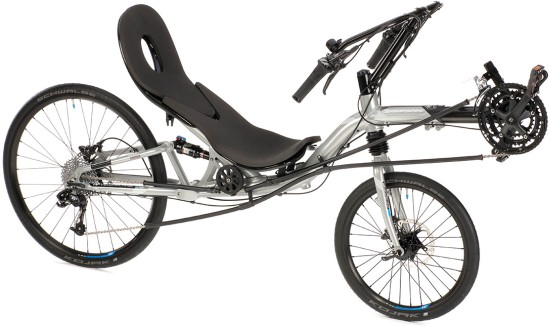
The short recumbent bicycles are not without reason today the most common representatives of
two-wheeled or single-lane recumbent bikes. They are aerodynamically excellent, they build
compact and light, they are maneuverable and easily manageable. In the entirety of the
properties, short-bed wheels are the "king class" of the recumbent bikes and therefore our
warmest purchase recommendation in general.
Simply put, the short recumbent bicycle is defined in that the bottom bracket is arranged in front
of the front wheel. As previously indicated, this arrangement offers the disadvantage that the
front wheel and heels can get in the way, at least in the case of tighter curves, when turning
on a small road, when passing from harassment to pedestrian paths and so on. The
recumbent cyclist gets used to stepping the inside of the curve forward when steering in to
release the full deflection of the front wheel. After a very short exercise, this limitation no
longer creates dangerous situations.
In principle, the positioning of the front wheel is to conflict with the target of taking the wheel
far to the rear so that the steering clearance is given, as some manufacturers do, or to push
the front wheel as close as possible to the pedal cranks so that the maximum possible
braking force can be achieved. If you go in the latter direction, i.e. to move the wheel forward,
you will achieve considerably better braking performance than are possible with upright
wheels. For wheels with front wheels far behind, the best steering free movement is given,
but the braking performance is almost only in the range of upright wheels.
In addition, for "ordinary" geometries, a small 20-inch front wheel is required for this to have
sufficient clearance behind the bottom bracket. Virtually almost all recumbent bikes (with the
exception of the high-racer) have 20-inch front wheels or smaller front wheels.
Flux S600
Fully-clad single-trackers
Fully dressed insignators have hardly prevailed due to their difficult manageability in
crosswinds and due to the difficult entry and exit. They have the potential to be the fastest
bicycles ever and also lead almost all speed records, partly in absurd constructions, in which
the drivers only see the road by camera. In principle, we still see potential for fully spaced
single-lane recumbent bikes suitable for everyday use and touring. But one step at a time...
Low rider recumbent bicycle with Bülk-fairing
High-Racer
High-racers have a slightly higher sitting position and in particular bottom brackets are also
significantly higher above the ground than with all other recumbent bikes. The purpose of this
measure is the use of larger impellers, which thus reduce the rolling resistance. And because
of this fact, high-racers are at least not really slower than "ordinary" recumbent bikes,
although the air resistance of the naked wheel is slightly greater due to the height. In many
cases, very flat backrest angles are also used in high racers to improve aerodynamics.
However, due to the focus, the high-racers have disadvantages in braking. The center of
gravity is higher and the larger front wheel is laid further back to ensure the freedom to the
pedals, resulting in a more unfavorable "brake angle" (see graphic above). The braking
performance is therefore worse than with most short-lived aircraft.
In principle, the high-racers can be assigned to the short-lying wheels.
The Flux S-Comp 26
Low rider recumbent bicycles
The Low rider recumbent bicycles are short recumbent bicycles whose sitting position is simply a few centimeters lower. The
Speedmachine pictured below is probably one of the highest Low rider recumbent bicycles, who take it out to
call themselves Low rider recumbent bicycles. Other properies fly with their butts only a few centimeters above
the ground and have flat backrest angles, so that the head hardly protrudes beyond the rear
wheel, to put it exaggerated.
Of course, Low rider recumbent bicycles have the advantage that the air resistance of the naked wheel is even
lower than with higher short bells, because simply less wheel looks out under the butt. Thus,
Low rider recumbent bicycles are basically the fastest recumbent bikes ever.
The low sitting position and eye height is particularly anxious about recumbent bike
beginners. There is probably actually a limit below which a potential for danger arises. It may
make sense that the eye level is not lowered below the lower edge of the car windows and
hoods, because above this limit a much better overview of the traffic situation is possible.
But the low sitting position also offers the advantage of the low drop height and the greater
manoeuvrability at high speed, which the low center of gravity offers. In addition, the low
center of gravity causes the maximum possible braking delay in the case of short recumbent
wheels. Recumbents are generally faster than all other bicycles and the braking distance
grows at the speed in square. For us, braking performance is one of the decisive safety
criteria for recumbent bikes.
For most Low rider recumbent bicycles, the relaxed running back chain runs next to the front wheel. When they
are more strongly turned in, the chain is thus pressed to the side, which is not a problem. It is
only not as comfortable as with higher short recumbents or with most other recumbent bikes. In the
end, the steering angle is not restricted as a result, only a little more steering force is
required. It would also be possible to guide the loose chain over the front wheel via a
pulley, so that the front wheel would be freely rotatable. But the usual low rider
fans prefer the smooth-running chain and take the collision between the front wheel and the
chain in the case of tight maneuvers.
For us, Low rider recumbent bicycles with said eye level are the absolute favorite.
The Speedmachine from HP-Velotechnik has been the classic among the tieflieger for
decades. She's not really the fastest and she's not really deep. But it is robust, suitable for
everyday use and travel, full suspension (which is mandatory for us) and therefore it is rightly
one of the best-selling slightly faster recumbent bikes.
It is a pity that so little has happened in this segment since the introduction of the
Speedmachine!
Have we forgotten anything else?
This text is, as I said, our own view and evaluation. We are pleased to receive criticism, hints
of forgotten significant recumbent bike types or incorrect statements. We will be happy to
include appropriate notices here immediately.